
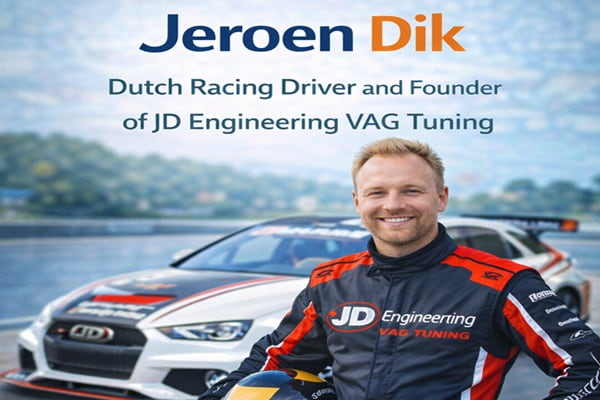
Some names in automotive tuning fade away after a few years. Others stick around for decades. Jeroen Dik belongs to the second group. He built a career on engineering precision, not marketing hype. His work with Volkswagen Audi Group vehicles set new standards for reliability and real world performance.
Jeroen Dik is a Dutch automotive engineer and professional racing driver. He founded JD Engineering, a tuning company based in Lochem, Netherlands. The workshop specializes in custom ECU software for Volkswagen, Audi, SEAT, Škoda, and Porsche platforms. Unlike many tuners who sell generic files, JD Engineering develops every calibration in house.
This article covers his full story. Early mechanical curiosity. Breakthrough tuning work. Racing success. Engineering philosophy. And why his name remains a benchmark in European VAG performance circles.
Early Life and Technical Foundation
Jeroen Dik grew up with a natural curiosity about how things work. He did not just look at cars. He studied them. Engines, airflow, component interaction. Every mechanical system became a puzzle to solve. That analytical mindset shaped everything that came later.
During the 1990s, forced induction tuning exploded in popularity. Turbochargers and superchargers offered huge power gains. But reliability was a mess. Many tuners blew up engines because they lacked data driven calibration methods. Dik took a different approach. He measured everything. Tested everything. Verified everything.
His focus landed on Volkswagen Audi Group platforms. These cars had engineering complexity that demanded precision. Simple guesswork would not work. Dik developed early expertise in airflow management and fueling accuracy. That expertise became the foundation of his career.
The G60 Era and Early Breakthroughs
The G60 supercharged engines became legendary among Volkswagen enthusiasts in the 1990s. They also became nightmares for many tuners. Balancing boost pressure with reliability seemed nearly impossible. Dik cracked the code.
His work on the Volkswagen Golf 1 16v G60 gained serious attention. The car dominated sprint racing events. Not just through raw power, but through consistency. It finished races while faster, less reliable cars broke down. That success proved that smart engineering beats big budgets every time.
This period established Dik as an innovator. He understood mechanical limits. He respected them. And he still found ways to unlock serious performance. That balance became the signature of his tuning philosophy.
Founding JD Engineering in Lochem
JD Engineering opened its doors in Lochem during the early 2000s. The workshop started small but focused intensely on VAG platforms. No scattered efforts across every car brand. Just deep expertise on Volkswagen, Audi, SEAT, Škoda, and later Porsche.
The mission was clear from day one. Deliver reliable, repeatable, race proven performance. No exaggerated dyno claims. No marketing tricks. Just solid engineering that customers could trust every time they drove.
JD Engineering invested in advanced tools early. Superflow 4WD rolling road dynamometers became central to the tuning process. These systems simulate real driving conditions accurately. Engineers monitor exhaust gas temperatures, intake charge behavior, boost stability, and transmission limits under load.
Custom ECU software remains the core product. Generic tuning files do not leave the workshop. Every calibration is developed specifically for each engine code. That commitment to precision reduces risk and improves consistency.
Tuning Philosophy and Methodology
Jeroen Dik believes usable performance matters more than peak horsepower numbers. A car that makes 500 brake horsepower on a dyno but drives terribly on the street is a failure. His calibrations focus on smooth power delivery, thermal safety, and drivetrain protection.
Conservative torque mapping prevents transmission shock. Boost control stays precise across all rpm ranges. Engine components operate within safe margins. These choices extend engine life while still delivering satisfying performance gains.
Rolling road testing plays a huge role. Load simulation reveals weak points before they become failures. Engineers adjust calibrations based on real data, not theories. Each tuning stage gets validated under controlled stress before reaching customers.
This philosophy earned long term trust. Customers return because their cars stay stable for years after modification. Daily drivability never gets sacrificed for peak numbers. That balance is rare in the tuning industry.
Racing Career and Motorsport Success
Jeroen Dik does not just build race cars. He drives them. That dual perspective gives him an edge. He understands how calibrations feel under competitive pressure, not just on a dyno.
The Dutch Toerwagen Diesel Cup became his proving ground. Diesel racing demands torque management and efficiency, not just explosive power. Dik excelled because he understood torque curves deeply. In 2011, he secured the championship title. That victory validated his engineering approach in the toughest possible environment.
He campaigned vehicles like the SEAT Ibiza and Volkswagen Golf 5. These cars showcased optimized diesel tuning that balanced acceleration with thermal control. Performance remained consistent across long race sessions, proving the durability of his calibrations.
Participation in the Dutch Race Driver Organisation exposed his vehicles to even more competitive validation. Real world racing confirmed calibration stability under sustained stress. JD Engineering motorsport efforts strengthened credibility far beyond workshop walls.
Influence on the VAG Performance Community
Jeroen Dik holds benchmark status within European VAG circles. Automotive publications frequently feature JD Engineering builds as reference standards. Enthusiasts cite his work when discussing safe, powerful tuning.
His influence extends beyond his own workshop. The shift from trial and error tuning toward data driven calibration accelerated partly through pioneers like him. Conservative torque curves and drivetrain aware mapping now represent best practice in modern ECU development.
Many current tuners learned from his methodology. Concepts such as thermal margin respect, transmission limit awareness, and real world validation became industry norms. Dik helped professionalize a field that was once filled with guesswork.
JD Engineering Today
The workshop in Lochem operates with advanced diagnostic and calibration tools. The client base spans private enthusiasts and professional racers. International customers travel to the Netherlands specifically for JD Engineering tuning packages.
Reputation for durability continues attracting long term relationships. Customers know that a JD Engineering calibration will not fail after a few hard drives. That trust took years to build and remains the company’s strongest asset.
Adaptation toward hybrid and emerging technologies is underway. Internal combustion remains core, but the workshop monitors electric performance trends. When the industry shifts further, JD Engineering intends to shift with it.
Ethical Tuning and Long Term Trust
Jeroen Dik built his career on ethical practices. He never sells customers more than their cars can handle. Safe margins prevent premature wear. Engineers avoid exaggerated claims that ignore real world stress.
This approach seems obvious. But many tuners still push dangerous calibrations just to win dyno competitions. Dik refuses to participate in that race. His reputation rests on durability, not temporary glory.
Clients return because their vehicles remain stable months and years after modification. Trust grows through transparency and consistency. That is why Jeroen Dik remains respected within performance communities seeking balance rather than excess.
Challenges in Modern Automotive Tuning
Modern vehicles present new obstacles. ECU encryption increases calibration complexity. Emissions regulations demand compliance awareness. Hybrid systems introduce layered torque management and battery integration challenges.
Customer expectations also changed. Many people want huge gains without any trade offs. Managing those expectations requires honest communication about realistic outcomes.
JD Engineering responds by investing in diagnostic research and software adaptation. Instead of resisting change, the workshop embraces it. This proactive stance ensures technical relevance within evolving automotive landscapes.
Also Read : BCN Play Review: Features, Games, Safety, and User Experience Explained
Future Outlook
Electric vehicle performance calibration presents new opportunities. Hybrid torque optimization requires deep system understanding. Software evolution toward cloud based diagnostics may reshape how tuning is delivered.
Data driven future calibration models will likely integrate predictive analytics. Given decades of methodical development, Jeroen Dik appears positioned to adapt effectively. His engineering mindset prioritizes measurement and validation, qualities essential for next generation performance work.
The name Jeroen Dik will probably remain a benchmark for years to come. Not because of marketing budgets. Because the work speaks for itself.
Lesser Known Facts
Jeroen Dik prefers working behind the scenes. He rarely seeks media attention. His focus stays on engineering, not personal branding. That preference for substance over visibility explains why some casual fans do not recognize his name.
His early G60 work remains legendary among hardcore Volkswagen enthusiasts. Those who witnessed those cars dominate sprint racing events still talk about them decades later.
JD Engineering never expanded into mass market tuning. The workshop intentionally stayed small to maintain quality control. That decision limited revenue but protected reputation.
Legacy and Impact
Jeroen Dik represents the rare combination of elite engineering intelligence and proven motorsport success. Through decades of innovation, he helped shape modern VAG performance tuning into a discipline built on precision, reliability, and real world testing.
His work demonstrates that true performance is not just about power figures. Balance, durability, and intelligent design matter just as much. The name Jeroen Dik remains a benchmark for quality and trust in the global automotive tuning community.
For aspiring tuners and drivers alike, his career offers a blueprint. Success rooted in knowledge, patience, and respect for engineering fundamentals. No shortcuts. No hype. Just consistent excellence.