
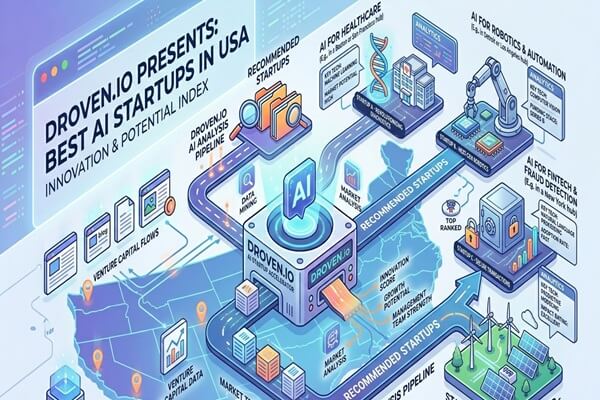
Artificial intelligence startups across the United States raised hundreds of billions of dollars in the past few years. But money alone does not tell you which companies actually matter. The Droven.io best AI startups in USA list cuts through the noise and highlights companies with real traction, strong products, and clear paths to long term success.
You will not find hype here. Just a practical look at the startups building the future of enterprise software, developer tools, search, and infrastructure. Some of these names you already know. Others are rising fast. All of them are worth watching.
What Makes a Startup One of the Best
Not every AI company deserves attention. Many raise money on slideshows and never ship a working product. The Droven.io best AI startups in USA focuses on five specific criteria. Product market fit comes first. Does the company solve a real problem that customers will pay to fix?
Revenue growth follows close behind. Great ideas mean nothing without paying users. The strongest startups show consistent annual recurring revenue growth and expanding customer lists.
Enterprise adoption matters because businesses vote with their budgets. When Fortune 500 companies sign contracts, that signals real value. Funding strength also counts, but only as a supporting factor. Large rounds from reputable investors suggest confidence, but they do not guarantee success.
Finally, unique AI advantage separates the leaders from the followers. Does the company have proprietary data, special algorithms, or a novel approach that competitors cannot easily copy? The best startups defend their position with something more than hype.
The Frontier Model Leaders
OpenAI dominates any conversation about AI startups. The company behind ChatGPT secured around 110 billion dollars in funding at a 730 billion dollar valuation in 2026. Backers include SoftBank, NVIDIA, and Amazon. Its ecosystem spans consumer tools, developer platforms, and enterprise solutions.
What makes OpenAI special is not just the models themselves. It is the scale of adoption. Millions of people use ChatGPT daily. Thousands of businesses build applications on its APIs. This installed base creates a massive moat that new competitors struggle to cross.
Anthropic takes a different approach while competing in the same arena. The company focuses on safe, reliable AI systems for enterprise customers. Its Claude models are known for strong reasoning capabilities and alignment with human values. A 30 billion dollar funding round at a 380 billion dollar valuation in 2026 shows that investors believe in this safety first strategy.
Anthropic has grown especially fast among organizations that worry about regulatory risk and brand safety. Banks, healthcare providers, and government agencies often choose Anthropic over more aggressive competitors because the models are less likely to produce problematic outputs.
The Infrastructure Backbone
Scale AI plays a less visible but equally critical role. Most people never see its name, but almost every major AI company depends on its services. Scale provides data labeling, model evaluation, and deployment support for organizations building large language models.
OpenAI, Meta, and Microsoft all rely on Scale for high quality training data. As the AI ecosystem matures, this infrastructure layer becomes more valuable. Building a great model is hard. Building a great model with bad data is impossible. Scale ensures that the data feeding these systems meets professional standards.
Search Gets Disrupted
Perplexity is redefining how people find information online. Instead of returning a list of blue links like traditional search engines, Perplexity answers questions directly with citations. Users get a conversational response backed by sources they can verify.
The company achieved an 18 billion dollar valuation and continues expanding into enterprise and government markets. Accuracy, citations, and usability set Perplexity apart from competitors that prioritize speed over correctness. For researchers, students, and professionals who need trustworthy answers, Perplexity offers a compelling alternative to traditional search.
Enterprise Knowledge and Productivity
Glean solves a problem every large organization faces. Important information gets buried across emails, documents, chat threads, and databases. Employees waste hours searching for what they need. Glean applies AI to index all of this internal knowledge and make it instantly searchable.
With over 250 million dollars in annual recurring revenue and rapid growth, Glean proves that enterprise AI can generate real money. Companies pay for the time savings and productivity gains. An employee who finds a document in five seconds instead of five minutes adds up to significant value across thousands of workers.
Vertical AI Specialists
Harvey focuses exclusively on legal and professional services. Lawyers spend countless hours reviewing documents, checking compliance, and drafting contracts. Harvey automates large portions of this work, allowing attorneys to focus on complex judgment tasks.
Thousands of legal professionals now use Harvey globally. This specialization matters because general AI tools often miss the nuance required in legal work. Harvey trains specifically on legal documents and workflows, achieving accuracy that general models cannot match.
Sierra tackles customer experience with AI agents that handle real conversations. Unlike simple chatbots that follow scripts, Sierra agents understand context, remember previous interactions, and complete tasks autonomously. A customer can cancel an order, change a delivery address, or request a refund without ever speaking to a human.
The company is growing fast because businesses are tired of chatbots that frustrate customers. Sierra agents actually solve problems, which reduces support costs and improves customer satisfaction simultaneously.
Developer Tools Take Off
Anysphere, the company behind Cursor, is transforming how developers write code. Cursor integrates AI directly into the coding environment, helping programmers write, edit, and debug software faster. A developer can describe what they want in plain English, and Cursor generates the corresponding code.
Enterprise adoption has been remarkable. Fortune 500 companies now use Cursor across their engineering teams. The product generates significant recurring revenue because developers gladly pay for tools that save them hours every week. In a field where time is money, Cursor delivers measurable returns.
Talent and Workforce Innovation
Mercor approaches AI from a different angle. Instead of building models or applications, Mercor connects organizations with skilled professionals who can work alongside AI systems. The platform handles hiring, matching, and payment, creating a workforce infrastructure for the AI economy.
As companies adopt more automation, they still need human judgment for complex tasks. Mercor helps them find the right people quickly. This talent focused model highlights a key reality. AI does not eliminate work. It changes what work looks like.
The Long Term Bet
World Labs represents the frontier of AI research. The company focuses on spatial intelligence and 3D world models. Instead of understanding text and images, World Labs builds systems that comprehend three dimensional spaces. Robots, autonomous vehicles, and virtual environments all require this capability.
The technology is not ready for mainstream deployment yet. But the potential applications in robotics, simulation, and immersive experiences are enormous. World Labs has strong funding and a long term vision. For investors who think in decades rather than quarters, this is one to watch.
Why This Variety Matters
The Droven.io best AI startups in USA list includes companies at every layer of the stack. Frontier models from OpenAI and Anthropic. Infrastructure from Scale AI. Search from Perplexity. Enterprise tools from Glean and Sierra. Vertical specialists like Harvey. Developer platforms like Cursor. Workforce solutions from Mercor. Long term research from World Labs.
This variety matters because people search for the best AI startups with different goals. Investors want high growth opportunities. Entrepreneurs look for business model inspiration. Developers seek tools they can use today. Enterprise buyers need solutions for immediate problems.
A good list serves all of these audiences. It does not pretend that one type of startup is better than another. It simply shows what exists and lets readers decide what matters to them.
Challenges Even the Best Startups Face
Being on the best list does not make a company invincible. Every AI startup faces serious headwinds. Heavy reliance on funding creates pressure. Most AI companies burn cash quickly on GPUs, researchers, and data centers. If investment slows, many will fail.
Regulatory pressure is increasing. Governments around the world are drafting AI safety laws, data privacy rules, and liability frameworks. Startups that ignore compliance do so at their own risk. Some may find their business models outlawed overnight.
Infrastructure costs remain brutal. Training and running large AI models requires expensive hardware. Smaller startups cannot compete with tech giants on compute power alone. They must find niches where efficiency and specialization beat raw scale.
Competition from Big Tech never stops. Google, Microsoft, Amazon, and Meta all have deep pockets and massive engineering teams. An AI startup that finds a profitable niche will soon face competition from these giants. Defensibility matters enormously.
Trends Shaping the Next Wave
AI agents are replacing traditional software. Instead of clicking through menus and filling out forms, users will describe what they want and AI agents will execute the tasks. This shift from tools to outcomes will remake the entire software industry.
Multimodal AI is expanding beyond text. Systems now understand images, video, audio, and 3D environments simultaneously. A customer service agent can see a photo of a damaged product, hear the customer’s description, and read the order history all at once. This contextual awareness creates much more capable systems.
Open versus closed models is becoming a strategic battleground. Open source models allow anyone to inspect, modify, and deploy the code. Proprietary models keep the technology secret. Each approach has advantages, and the competition between them is reshaping the economics of AI.
AI native companies are replacing AI enabled companies. The first wave of AI startups added chatbots to existing products. The new wave builds entirely around AI from day one. Every feature, every workflow, every user interface assumes intelligence. These companies move faster because they have no legacy constraints.
Who Should Follow These Startups
Investors should track funding rounds, revenue growth, and enterprise adoption. The best opportunities often come before mainstream recognition. A startup that looks small today could be the next industry leader.
Entrepreneurs should study business models and product strategies. What problems are these companies solving? How do they acquire customers? What makes their approach defensible? The answers provide a roadmap for new ventures.
Developers should explore APIs and tools from these startups. Building with AI is easier than ever. The best way to understand the technology is to use it. Build a small project. Break things. Learn what works.
Enterprise buyers should evaluate solutions for their specific needs. Not every AI tool is right for every business. Test products thoroughly. Measure results. Scale what works.
The Bottom Line
The Droven.io best AI startups in USA represent the leading edge of technological change. They are not theoretical research projects. They are real companies with real customers, real revenue, and real products. Some will become giants. Others will fail. All of them are worth understanding.
Pay attention to what they build. Learn from their successes and their mistakes. The future of business, software, and work is being written right now. These startups hold the pen.