The United States builds more future technology than almost any other country. But knowing which trends actually matter versus which ones are just marketing noise makes a real difference for businesses, workers, and investors. Droven IO Future Technology USA captures exactly this intersection of American innovation and practical application.
You will not find hype here. Just a clear look at how artificial intelligence, cloud computing, edge systems, robotics, and digital twins are reshaping American industries right now. Let us walk through what is real, what is coming, and how to prepare.
What Droven IO Future Technology USA Really Means
Droven IO Future Technology USA combines two important ideas. First, the editorial focus of Droven.io on explaining technology clearly. Second, the actual direction of American technological change. Together they point to a landscape where AI, cloud infrastructure, cybersecurity, and automation are no longer separate conversations.
They are one connected transformation affecting how businesses operate, how workers build skills, and how investors allocate capital. A complete understanding requires looking at both the technologies themselves and how they get deployed across the country.
Artificial Intelligence Drives Everything Forward
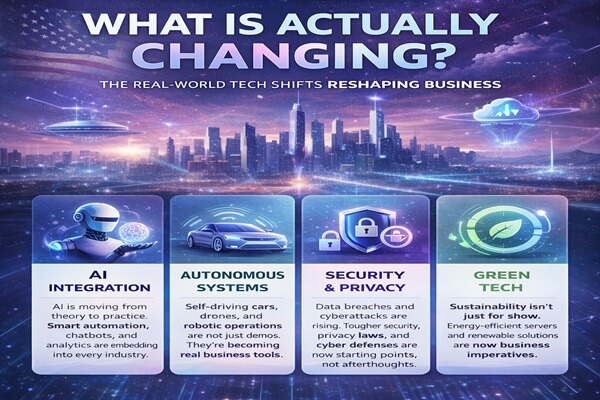
AI serves as the engine for most future technology in America. Not the Hollywood version of sentient robots, but practical systems that automate customer support, detect fraud, optimize supply chains, and assist with coding. These are live deployments happening right now in thousands of organizations.
The National Institute of Standards and Technology has published frameworks for managing AI risk. That matters because responsible deployment requires transparency, bias detection, and human oversight. Companies that ignore governance find themselves explaining failures to regulators and angry customers.
For businesses, AI creates real efficiency gains. For workers, it changes which skills command higher salaries. For publishers covering Droven IO Future Technology USA, AI remains the expected starting point because readers want to know how machine intelligence affects their daily work.
Cloud Computing Provides the Foundation
None of this future technology runs without cloud infrastructure. American companies rent compute power, storage, and databases from massive providers instead of building their own data centers. This shift from owning hardware to accessing services changes everything about speed and flexibility.
But cloud alone is no longer enough. Edge computing processes data closer to where it is created, inside factories, hospitals, and retail stores. That reduces delays and enables real time decisions. A self driving car cannot wait for a round trip to a central cloud server. It needs answers in milliseconds.
Connected devices, industrial sensors, and smart logistics systems all produce continuous streams of data. Edge systems handle that data locally. Only the important summaries get sent to the cloud. This hybrid model defines modern American infrastructure.
Robotics and Physical Automation Grow Fast
Software automation gets all the attention, but physical robotics is expanding rapidly across the United States. The country ranks as the world’s third largest market for industrial robot installations. Automotive manufacturing leads the way, but warehousing and logistics are catching up quickly.
AI paired with sensors and machine vision creates machines that see, grip, and move with increasing sophistication. A warehouse robot that picks items from shelves works alongside human workers rather than replacing them entirely. The combination of human judgment and robotic consistency delivers the best results.
For readers of Droven IO Future Technology USA, understanding robotics matters because future technology is not just about apps and dashboards. It is about physical systems that manufacture products, move packages, and build infrastructure.
Digital Twins Connect the Physical and Digital Worlds
Digital twins are virtual copies of physical systems. A factory, a wind turbine, or even an entire city can have a digital twin that mirrors its real world counterpart. Engineers run simulations on the twin before making changes to the real system.
This technology saves enormous amounts of money. Instead of shutting down a production line to test a new configuration, you test it in the digital twin first. If something breaks in the simulation, no harm done. Fix the design and try again.
NIST has identified digital twins as a key technology for advanced manufacturing. They bring together AI, cloud, IoT, and simulation in a way that reflects how sophisticated American industry actually operates. Including digital twins in any serious discussion of future technology shows real depth of understanding.
Energy and Infrastructure Matter More Than You Think
Future technology in America has a dirty secret. It consumes massive amounts of electricity. AI models, cloud data centers, and edge networks all need power and cooling. The Department of Energy has warned that clean energy resources must expand to meet this demand.
Data center construction is booming in regions with cheap power and favorable climates. Northern Virginia, Dallas, and Phoenix have become major hubs. Each new facility requires enough electricity to power a small city.
Sustainability is not just an environmental concern. It is an operational necessity. Companies that ignore their energy footprint will face higher costs and potential regulatory pushback. A complete article on Droven IO Future Technology USA must acknowledge that software runs on physical hardware, and that hardware needs resources.
Governance and Trust Become Competitive Advantages
Anyone can build a prototype AI. Deploying one that customers trust is much harder. The American market is moving toward requiring transparency, explainability, and accountability from AI systems.
Bias detection matters because models trained on historical data can perpetuate past discrimination. A hiring algorithm trained on ten years of mostly male resumes might unfairly favor male candidates. Fixing these problems requires deliberate effort and ongoing monitoring.
Security is equally critical. AI systems can be tricked, manipulated, or stolen. Protecting them requires the same discipline applied to traditional software, plus new techniques specific to machine learning. Companies that prioritize governance will win trust and market share.
Startups Lead the Commercialization Charge
Established tech giants get the headlines, but American startups are doing the gritty work of turning research into products. Venture capital data shows that AI and machine learning captured nearly two thirds of all US startup funding in 2025. That is an extraordinary concentration of capital.
These young companies are building tools for AI infrastructure, cybersecurity, cloud optimization, industrial robotics, and digital workflows. They are more agile than large incumbents and willing to take bigger risks. Many will fail, but the ones that succeed will define the next decade of American technology.
For investors and entrepreneurs following Droven IO Future Technology USA, the startup ecosystem represents both opportunity and chaos. The pace of change is exhilarating and exhausting at the same time.
How Different Industries Apply Future Technology
Manufacturing uses digital twins and predictive maintenance to reduce downtime. Sensors on equipment detect early signs of failure and schedule repairs before breakdowns occur. That keeps production lines running and saves millions of dollars.
Healthcare deploys AI for diagnostics, patient monitoring, and administrative workflows. A radiologist assisted by AI reads scans faster and catches more anomalies. Hospital administrators use automation to handle scheduling, billing, and insurance verification.
Finance relies on AI for fraud detection and risk analysis. Algorithms scan millions of transactions in real time, flagging suspicious patterns that human analysts would miss. Trading firms use machine learning to find market inefficiencies and execute trades in milliseconds.
Logistics companies optimize routes and predict delivery windows using AI. A package traveling from Chicago to Atlanta gets routed based on real time traffic, weather, and historical data. Customers receive accurate arrival estimates because the system learns from past deliveries.
Education is adopting AI assisted learning tools that adapt to individual student needs. A math program notices when a student struggles with fractions and provides extra practice. The same program moves faster when a student demonstrates mastery.
The American Workforce Is Changing
Future technology does not just change what businesses do. It changes how people work. AI related roles, data analysis, cybersecurity, and cloud operations are growing rapidly. Routine information processing tasks are being automated or restructured.
That does not mean mass unemployment. It means different jobs. A customer service representative shifts from answering the same questions repeatedly to handling complex escalations that the AI cannot resolve. An accountant spends less time on data entry and more time on strategic analysis.
Workers who build literacy in AI, automation, and digital systems will stay relevant. Those who ignore these changes will struggle. Community colleges and online learning platforms are scrambling to offer relevant training. Employers are retraining existing workers rather than hiring entirely new teams.
The timeline for these changes is not decades. It is years. Companies are moving fast because their competitors are moving fast.
What the Next Three to Five Years Look Like
Some technologies are growing right now. AI deployment, cloud modernization, and cybersecurity are active markets with proven business models. Companies that ignore them fall behind immediately.
Other technologies are entering mainstream adoption. Edge computing, digital twins, and industrial IoT are moving from early adopter phase to broad acceptance. The tools are mature enough for conservative organizations to trust.
Longer term developments like quantum computing and advanced autonomous systems remain on the horizon. They will matter eventually, but not for most businesses in the next few years. Do not let hype about distant futures distract from actionable opportunities today.
Common Questions About Droven IO Future Technology USA
Many people ask whether Droven.io is a software tool or a service provider. It is neither. The platform focuses on education and analysis, helping readers understand technology rather than selling them software.
Beginners can start learning by focusing on AI basics and real world use cases. Cloud computing fundamentals also provide a solid foundation. The goal is not to become a programmer overnight. It is to understand enough to make better decisions.
Small businesses benefit from future technology by adopting scalable tools incrementally. Start with one automation project that saves measurable time or money. Expand only after proving value.
Investors should watch AI infrastructure, cybersecurity, and startup activity in these sectors. Capital is flowing toward practical applications rather than pure research.
Final Thoughts on America’s Technology Future
Droven IO Future Technology USA captures a genuine shift in how the country builds and deploys innovation. The focus is moving from experimentation to implementation, from hype to hard results. AI, cloud, edge, robotics, and digital twins are not separate trends. They are layers of a single transformation.
Success requires balancing innovation with governance, speed with safety, and automation with human skills. The organizations that get this balance right will thrive. Those that do not will struggle to catch up.
Start building skills now. Apply technology to real problems. Stay curious and skeptical in equal measure. That is the path forward.