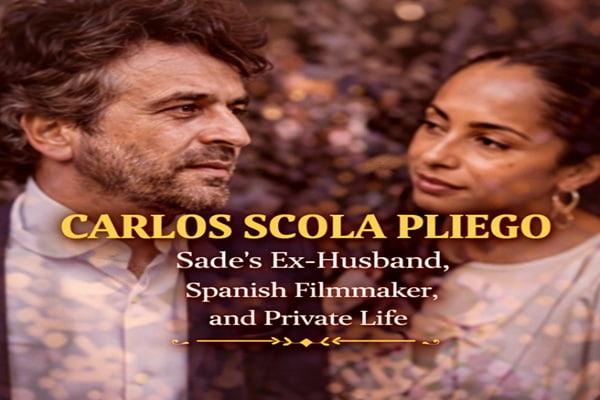
Some names stay alive in search engines not because people chase fame, but because they choose silence. Carlos Scola Pliego is exactly that kind of name. He is a Spanish filmmaker who worked on a James Bond movie, directed his own documentaries, and then disappeared from public life. Most people know him as the only man singer Sade Adu ever married. But his story goes deeper than that single label. He built a real career in cinema, worked behind the scenes on major productions, and then walked away from it all without looking back.
This article covers everything about Carlos Scola Pliego. His early years in Spain, his film work, his marriage to Sade, their divorce, and where he is now. No fluff. No filler. Just the facts and the story behind the mystery.
Who Is Carlos Scola Pliego
Carlos Scola Pliego is a Spanish filmmaker, director, and script supervisor. He worked on Spanish films, international blockbusters, and personal documentary projects. His professional life spanned from the late 1970s to the mid 2000s. Then he stepped out of the spotlight completely.
Public curiosity about him comes from two places. First, his marriage to Sade Adu, the Nigerian British singer known for hits like Smooth Operator and No Ordinary Love. Second, his extreme privacy. He never gave interviews. He never posed for photos. He never used his connection to fame for personal gain. That silence makes people want to know more.
Early Life and Spanish Roots
Carlos Scola Pliego was born in Spain. His exact birth date is not public. He never shared his age, his parents’ names, or details about his childhood. That lack of information is intentional. Some people build brands on personal stories. He built his life on keeping those stories private.
Spain has a rich film culture. Directors like Luis Buñuel and Pedro Almodóvar put Spanish cinema on the world map. Growing up in that environment likely shaped his early interest in visual storytelling. He came from a Catholic family, according to available records, but beyond that, his early years remain a blank page.
That blank page is not a mistake. It is a choice. And that choice defines his entire public image.
How He Learned Filmmaking
No verified records show Carlos attending film school. Instead, he learned by doing. He started as a script supervisor, a job that requires intense attention to detail. Script supervisors track every scene, every line of dialogue, and every camera angle to make sure nothing breaks continuity.
That role taught him the mechanics of filmmaking from the ground up. He learned how directors think, how crews move, and how stories translate from page to screen. Hands on experience in the 1970s and 1980s was common. Many working filmmakers from that era skipped formal education and learned on set.
His first known credit came in 1979 on a Spanish film called La boda del señor cura. From there, he moved steadily upward.
Film Career and Notable Projects
Carlos worked on at least nine film and television projects between 1981 and 1985. He started as a script supervisor and later became an assistant director. Assistant directors manage the shooting schedule, coordinate cast and crew, and keep production running on time. It is a stressful job that requires calm under pressure.
In 1983, he worked as a second assistant director on Never Say Never Again, a James Bond film starring Sean Connery. Some sources say he was not officially credited, but multiple industry records confirm his involvement. That same year, he worked on Curse of the Pink Panther, another major international production.
He also contributed to the television miniseries Christopher Columbus, which starred Gabriel Byrne. The project had a large cast and complex shooting requirements. His role as assistant director helped keep everything organized.
These credits show something important. Carlos was not a struggling artist looking for a break. He was a working professional trusted by major productions.
Documentary Work and Personal Vision
Most assistant directors stay behind the scenes forever. Carlos did something different. He stepped forward to direct his own projects.
In 1988, he wrote, directed, and produced a documentary called Ngira: Gorilas en la montaña. The film was shot in the Democratic Republic of Congo and focused on mountain gorillas. This was not a quick tourist project. It required travel to remote locations and a genuine interest in wildlife conservation.
He followed that with another documentary, Donde termina el corazón, which explored African culture and human experiences across different regions. These films revealed a different side of him. He was not just a hired hand on Hollywood sets. He had his own voice and cared about real world stories.
These documentaries did not make him famous. But they proved he was a real filmmaker, not just a celebrity spouse.
Meeting Sade Adu
Carlos met Sade Adu in Spain in 1985. She was there filming music videos for her album Promise. He was part of the production crew. At first, their relationship was strictly professional. No romance. Just work.
But Sade was going through a difficult time. Her father had died, and she felt exhausted by media attention. She decided to stay in Spain longer to find peace. During that period, she reconnected with Carlos. Away from cameras and reporters, their friendship deepened into something more.
Sade later said she fell madly in love with him. She even started calling him her husband before they officially married. That kind of language from someone as private as Sade shows how deeply she felt.
The Wedding in a Spanish Castle
Carlos Scola Pliego and Sade Adu married on October 11, 1989. They chose a castle in Spain for the ceremony. It was private, elegant, and completely away from the press. Only close friends and family attended.
After the wedding, they lived together in Madrid. Both valued their privacy above everything else. Carlos continued working on film projects. Sade worked on her music. Their home life stayed quiet and out of the headlines.
She released the album Stronger Than Pride during their time together. The album included the hit Nothing Can Come Between Us. Fans often wonder how much Carlos influenced that music. Neither has ever said.
Why the Marriage Ended
The marriage did not last long. They separated roughly one year after the wedding. The divorce was finalized in 1995. Neither Carlos nor Sade ever explained exactly what went wrong.
Sade gave a rare interview years later where she called the marriage a bad situation. She said it took her about five years to feel like herself again. That timeline suggests deep emotional pain.
Many fans believe her 1992 album Love Deluxe was shaped by that heartbreak. The song No Ordinary Love, with its aching lyrics and slow burn melody, feels like a window into that period. Whether it is directly about Carlos or not, the timing lines up.
Carlos never commented on the divorce. He never told his side of the story. That silence is consistent with everything else about him.
Did They Have Children
No. Carlos and Sade did not have children together. Their marriage ended before they started a family. Sade later had a daughter, Ila, with another partner. Carlos has no known children.
This fact matters because it keeps their connection purely between them. No shared custody arrangements. No co parenting stories. Just two people who loved each other, married, and then went their separate ways.
Life After Sade
After the divorce, Carlos withdrew even further from public life. He continued working in film quietly. His last known credit came in 2007 on Goal II: Living the Dream. After that, no new projects appeared.
He did not give interviews. He did not write a tell all book. He did not sell his story to tabloids. He simply went back to Spain and lived his life.
Some reports suggest he wrote a book called Salvador: Un apunte de filosofía sencilla and translated literature into Spanish. But those claims are hard to verify because he never promoted them publicly.
His estimated net worth as of 2026 is around 70 million dollars. That wealth likely came from decades of film work and careful financial management. Unlike many people connected to famous celebrities, he never tried to monetize his past relationship.
Also Read : Asalia Nazario: Zoe Saldaña’s Mother, Her Sacrifice, and Quiet Strength
Where Is Carlos Scola Pliego Now
As of 2026, Carlos Scola Pliego lives in Spain. He maintains an extremely low profile. No social media. No public appearances. No interviews. He has not remarried publicly, and no information about new relationships exists.
He is believed to be retired from filmmaking. His last credit was nearly twenty years ago. At this point, he seems content to live quietly away from the industry that once employed him.
This level of privacy is rare. Most people who taste any amount of fame try to hold onto it. He did the opposite. He let go completely.
Why People Still Search for Him
Carlos Scola Pliego remains a subject of online searches for several reasons. First, his connection to Sade Adu. She is a beloved musician whose fans care about her personal history. Understanding who she loved helps them understand her music.
Second, the mystery itself. When someone refuses to be known, curiosity grows. His silence creates a vacuum, and people try to fill it with answers.
Third, his film career has genuine merit. He worked on a James Bond movie. He directed his own documentaries. He was not a nobody who married a star. He was a working artist with real credits.
What His Story Teaches
Carlos Scola Pliego shows that a person can contribute to culture without becoming a celebrity. He made films. He worked hard. He fell in love with a famous person. Then he walked away when the relationship ended.
Not everyone needs to tell their story. Not everyone owes the public an explanation. Some people simply want to work, love, and then live in peace.
That might not make for a flashy biography. But it makes for a real one.