
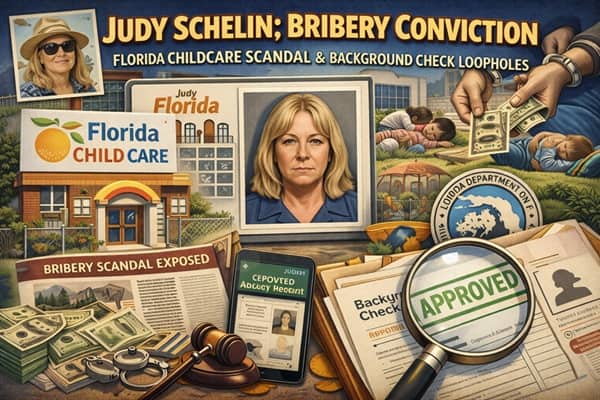
Judy Schelin is not a celebrity. She never sought fame or public attention. Yet her name appears in court records, news articles, and policy discussions across Florida. The reason is simple. Her case exposed dangerous gaps in how the state vets people who care for children.
For years, Schelin worked as a childcare administrator in Broward County. She managed programs that fed low income kids and oversaw daycare centers serving hundreds of families. Parents trusted her. The state trusted her. That trust was misplaced.
A 2010 federal bribery conviction should have ended her career in childcare. But because of a quirk in Florida’s background check system, she continued working with children for years afterward. Her story is not just about one person’s mistakes. It is about systemic failures that put vulnerable kids at risk.
Early Life and Move to Florida
Judy Lynn Schelin was born in December 1951 in Merrill, Iowa. That small farming town in the northwest corner of the state runs on trust and close relationships. Everyone knows everyone. That background shaped her early years, but she eventually left the Midwest behind.
She moved to South Florida and built her entire professional life in Broward County. The shift from rural Iowa to the complex world of nonprofit administration was significant. Broward County hosts a large network of state funded early childhood education programs. Schelin found her place in that world.
For nearly two decades, she worked in childcare administration and nonprofit management. Her career focused on publicly funded daycare programs serving low income families. These programs depended entirely on government money and public trust. Schelin became a known and trusted name in local social services.
Professional Responsibilities and Power
As a childcare administrator, Schelin held significant responsibility. She managed budgets for subsidized childcare programs across multiple facilities. She oversaw staff and ensured compliance with state and federal funding requirements. She handled financial reporting to government agencies.
One of her main associations was with Riverwood Center, a Broward County nonprofit that delivered subsidized childcare to families relying on government assistance. The scale was substantial. These programs served hundreds of children daily and handled millions in public funds.
Administrators in these roles face high ethical expectations. They work with vulnerable populations and public money. Any breach of trust can have severe consequences. Schelin’s position required honesty, transparency, and careful stewardship. She failed on all three counts.
State Investigations Before Federal Charges
Before any federal charges emerged, state auditors were already looking at Riverwood Center’s billing records. What they found was not a one time mistake. It was a pattern that stretched across multiple audit cycles.
The issues were serious. Luxury car leases billed to the childcare program. Resort hotel stays logged as program expenses. Personal travel disguised as operational costs. Administrative fees that exceeded state guidelines. Program resources benefiting private family business interests.
When confronted, Schelin voluntarily repaid some amounts while disputing others. She claimed she had misunderstood the billing rules. An administrative law judge did not accept that explanation. He ordered her to repay nearly $150,000 to the daycare centers and the state.
That finding should have been a warning. But Schelin continued working in childcare administration. The state did not bar her from the field. The system allowed her to keep going.
The 2010 Federal Bribery Conviction
The turning point came in 2010. Under the name Judy Perlin, Schelin pleaded guilty to federal bribery charges. Prosecutors proved she accepted approximately $40,000 in kickbacks while overseeing a federally subsidized youth education program.
The scheme worked like this. A catering company called Diana Food Group wanted to participate in a lucrative food program. Schelin used her authority to secure their participation. In exchange, she received illegal payments. The money was meant to feed low income children. Instead, it went into her pocket.
Beyond the bribes themselves, investigators found other problems. She paid roughly $20,000 in salaries to family members using federal funds. She used program money to advertise her daughter’s private business in a national publication. These actions showed a pattern of treating public resources as personal property.
The court sentenced her to two years of probation and a $3,000 fine. She also received a seven year ban from participating in USDA funded programs. That ban seemed significant. But it had a glaring loophole. It only applied to her working under the name Judy Perlin.
The Multiple Names Problem
Judy Schelin appears in public records under at least four different name variations. Judy Schelin was her primary professional name. Judy Perlin was the name on her federal conviction. Judy Scherlin appears as a variant spelling in some records. Judy Schindel comes from her marriage to Gary Schindel.
Name changes through marriage are normal and legal. Millions of women do it every year. But in Schelin’s case, the practical result was a clean background check for anyone searching only her current name.
Any employer who searched Judy Schelin found nothing. The 2010 federal bribery conviction lived under Judy Perlin in federal court records. Without someone specifically cross referencing both names, the connection simply did not appear. That gap sat undetected for years. Then 2015 happened.
The Boca Raton School Controversy
In early 2015, Schelin was hired as a teacher in the infant program at Congregation B’Nai Israel, a religious school in Boca Raton. She worked with children as young as six weeks old. Parents trusted the school to keep their babies safe.
The school ran background checks through two separate agencies. The Florida Department of Children and Families and the Palm Beach County Sheriff’s Office both cleared her. Both checks returned the same result. No arrest history on record.
Schelin also signed a sworn affidavit stating she had never been fined, disciplined, or faced legal sanctions in any professional capacity. That affidavit was false. Her federal conviction was a matter of public record. It was just filed under a different name.
Her care of the infants was described as superb. The school initially defended the hiring. But when local media connected Judy Schelin to Judy Perlin and published the link, parents reacted immediately. The concealment of a felony conviction combined with a false affidavit made her continued employment impossible. She was fired in January 2015.
What the Case Exposed About Florida Law
The Judy Schelin scandal revealed two concrete failures in Florida’s system for protecting children in licensed care settings. Neither failure was obscure. Both were embarrassingly simple.
First, bribery was not a disqualifying offense. Officials from the Early Learning Coalition of Broward County confirmed that federal bribery was not on Florida’s list of crimes that automatically barred someone from working in a licensed childcare facility. A person with a felony conviction for stealing from a children’s food program could legally take a childcare job. There was no rule against it.
Second, background checks were name dependent. The DCF background check did not reveal the federal conviction because it was run under the name Schelin, not Perlin. Florida’s standard screening systems queried by surname. Without cross referencing Social Security numbers, birth dates, or other identifiers, a conviction under a prior name stayed completely invisible.
These gaps meant that someone could commit a serious financial crime against a children’s program and still walk into a childcare job years later. The system assumed that background checks would catch problems. But the system was built wrong.
Family and Personal Background
Biographical records identify Judy Schelin as originally from Merrill, Iowa. She is the sister of James Carlysle Schelin, who resided in Mesa, Arizona, and passed away in 2022. She has been identified as married to Gary Schindel.
Family details often appear in public records to distinguish individuals with similar names. They provide genealogical clarity rather than implying involvement in any legal matters. Her family members have not been implicated in her professional conduct.
Where Is Judy Schelin Now?
As of 2026, Judy Schelin is no longer active in childcare administration or nonprofit management. She reportedly works as a payroll manager, still in administrative work but well outside the regulated childcare space.
She has no verified public social media presence. Her current lifestyle appears quiet and private. The ambition that drove her earlier career has faded. She lives in Boca Raton, Florida, largely out of public view.
Her net worth is estimated between $150,000 and $250,000. That figure reflects a modest lifestyle, not the wealth one might associate with someone who controlled millions in public funds. The money she improperly used went to operational expenses and perks, not to building personal assets.
Important Distinction: Not Judge Judy
For anyone who arrived here through a confused search, a clear clarification is necessary. Judy Schelin and Judge Judy Sheindlin are completely different people. The names sound similar, but they share nothing in common.
Judge Judy Sheindlin is a television personality and former family court judge. Judy Schelin is a former Florida childcare administrator with a federal bribery conviction. Confusing the two would be a serious error.
Policy Reforms Inspired by the Case
The Schelin case pushed advocates and legislators to call for specific reforms. Expanded disqualifying offense lists covering federal financial crimes tied to children’s programs became a priority. Background checks that cross reference Social Security numbers and dates of birth rather than relying on names alone gained support.
Mandatory disclosure of all names used in the prior decade became another proposed reform. Stronger penalties for false affidavits in childcare hiring also gained traction. These changes aim to close the specific loopholes that allowed Schelin to continue working with children after her conviction.
Some of these reforms have been implemented. Others remain under discussion. The pace of change in government regulation is slow. But the Schelin case continues to be cited as a textbook example of why reform is necessary.
Also Read : Uncuymaza Meaning: Andean Concept in Art, Design, and Leadership
Lessons for Parents and Institutions
Parents should understand that background check systems are not perfect. A clean report does not guarantee a person has no relevant history. Asking questions about name changes and requesting disclosure of all prior names can provide additional protection.
Institutions should move beyond name based checks. Using Social Security numbers and date of birth as primary identifiers closes the loophole that Schelin exploited. Verifying affidavits against court records in multiple jurisdictions adds another layer of security.
Schools and daycare centers should also train hiring staff to recognize red flags. Multiple name changes without clear documentation, gaps in employment history, and reluctance to authorize thorough background checks all warrant closer examination.
Final Thoughts
Judy Schelin’s story is not a success story. It is a cautionary tale about broken systems and misplaced trust. She held positions that should have gone to people with clean records and strong ethics. Instead, she used those positions for personal gain while continuing to work with children.
Her case exposed gaps that should never have existed. A bribery conviction involving children’s food programs should automatically disqualify someone from childcare work. Name based background checks that miss convictions under prior names are dangerously inadequate.
The lessons from this case continue to resonate. Lawmakers cite it when arguing for stronger oversight. Parents think about it when choosing daycare centers. Regulators reference it when designing background check systems. Judy Schelin’s name will not be remembered with admiration. But her case may still serve a useful purpose by pushing the reforms needed to protect vulnerable children.