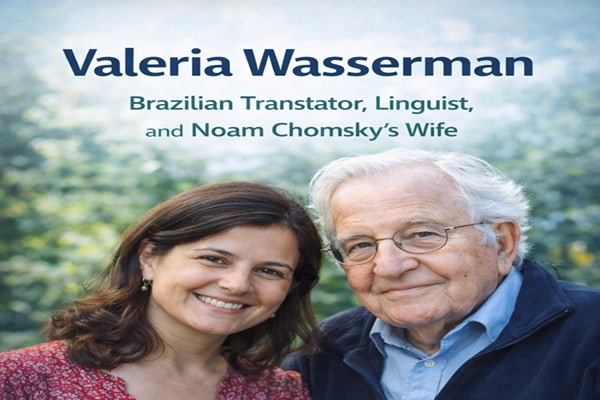
Few people wake up one day to find their private life splashed across global headlines. Valeria Wasserman never sought the spotlight. She built a quiet career in translation, worked with legal documents, and lived a normal life in Brazil. Then she married Noam Chomsky, one of the most famous intellectuals on the planet. Everything changed.
But here is what makes her story worth telling. Valeria is not just “Chomsky’s wife.” She holds her own expertise. She studied law and linguistics at top Brazilian universities. She worked as an investment analyst and legal assistant before transitioning into translation. Her professional journey shows how precision, analytical thinking, and language skills can open unexpected doors.
This article covers her full background, career, marriage, public controversies, and the lessons hidden in her path. Read carefully. You will not need another source after this.
Early Life and Education in Brazil
Valeria Wasserman was born in Brazil in 1963. She grew up far from American intellectual circles or political debates. Her childhood revolved around family, school, and a growing curiosity about how language works. That curiosity did not stay small.
She pursued higher education with serious focus. First, she attended Universidade Federal Fluminense (UFF) to study law. Law school trained her to read carefully, spot hidden meanings, and argue with evidence. Those skills later made her an exceptional translator. She then moved to Pontifícia Universidade Católica do Rio de Janeiro (PUC Rio) for languages and linguistics. That combination law plus linguistics is rare. Most people pick one path. She mastered both.
She also took capital markets courses at Universidade de São Paulo. That gave her a working knowledge of finance and investments. So by her mid twenties, Valeria understood legal systems, language structures, and financial markets. Not a bad foundation for any career.
Professional Work Before Public Attention
Valeria did not jump straight into translation. She started in the legal and financial sectors. She worked as an investment analyst. She also held legal assistant positions. These jobs demanded attention to detail, long hours of reading, and the ability to explain complex ideas clearly. Sound familiar? That is exactly what top translators do every day.
Eventually, she followed her passion for language into full time translation work. She focused on Portuguese English projects. That meant helping Brazilian clients communicate with English speaking partners and vice versa. But she did not handle simple tourist phrases or casual emails. She worked on academic texts, cultural projects, and complex documents where one wrong word could change everything.
Her employer at the time was ArtVentures Cultural Projects & Translations. Through that organization, she contributed to literary translation and cross cultural communication. Her legal background gave her an edge. She could translate contracts, academic papers, and technical materials with confidence. Many translators avoid legal texts because the stakes are high. Valeria leaned into that difficulty.
Meeting and Marrying Noam Chomsky
So how does a Brazilian translator end up married to one of America’s most famous linguists and political critics? The public does not know every detail of their first meeting. But we know they married in 2014. Chomsky was 85 years old at the time. Valeria was 51. The age gap drew immediate attention.
People asked why Chomsky would marry again after his first wife Carol died in 2008. Others questioned what Valeria saw in a man nearly twice her age. But those questions miss the point. Chomsky built his career on the study of language. Valeria spent her life working with language as a translator and linguist. They shared a professional foundation. That shared interest likely brought them together.
Since the marriage, Valeria has split time between the United States and Brazil. She continued her translation work while also stepping into a new role as Chomsky’s partner and later as his caretaker. That transition from independent professional to public figure and caregiver happened gradually. Then a health crisis forced her fully into the spotlight.
Health Challenges and Public Misinformation
In 2023, Noam Chomsky suffered a serious stroke. He was 94 years old. Recovery from a stroke at that age is slow and uncertain. Valeria became his primary caregiver. She managed his medical care, communicated with hospitals, and handled questions from the media. That is a heavy burden for anyone.
Then things got worse. In June 2024, false reports spread online claiming Chomsky had died. The rumors ran wild across social media and news sites. Valeria had to step forward publicly to correct the record. She stated clearly that her husband was alive and recovering. Her calm, factual response stopped the misinformation cold. Many people admired her composure during that stressful time.
That moment showed something important about Valeria. She does not enjoy public attention. But when accuracy and her husband’s dignity were at stake, she acted decisively. No drama. No emotional outbursts. Just the facts.
The Epstein Controversy and Public Scrutiny
No story about Valeria Wasserman would be complete without addressing the Jeffrey Epstein connection. In early 2026, questions surfaced about past interactions between Chomsky and Epstein. Epstein was a convicted sex offender who associated with many powerful people before his crimes became fully public.
Valeria issued a public statement acknowledging mistakes. She expressed regret for past decisions regarding Epstein and offered sympathy to his victims. That statement drew sharp reactions. Critics pointed out that Chomsky spent decades condemning powerful abusers. Seeing his name linked to Epstein felt contradictory to many people.
Valeria handled this controversy directly. She did not hide or make excuses. She admitted fault, expressed regret, and moved forward. That kind of straightforward response is rare in public life. Most people hire crisis managers and release vague non apologies. She simply told the truth as she saw it.
Family Life and Step Parenting
Valeria and Noam Chomsky do not have children together. But she became a stepmother to his three children from his first marriage: Aviva, Diane, and Harry. Blended families come with unique challenges. Adding public attention to that mix makes everything harder.
The public knows very little about Valeria’s relationships with her stepchildren. That is by design. She keeps family matters private. What we do know is that she stepped into an existing family structure as an outsider and made it work. That requires emotional intelligence and patience two qualities she clearly possesses.
Her own parents and early family background remain largely undocumented. She grew up in Brazil in a household that valued education. Beyond that, she has kept those details to herself. Some people find that frustrating. But respecting her privacy is part of understanding who she is.
Work Philosophy and Translation Approach
Valeria believes translation is not just word swapping. It is about preserving meaning, emotion, and cultural context. A legal contract translated poorly can cause lawsuits. A literary work translated badly loses its soul. She approaches every project with precision and respect for the original text.
Her legal training shows in her work habits. She checks every sentence twice. She researches terms she does not know immediately. She asks clarifying questions when instructions are vague. Those habits seem simple, but many translators skip them to save time. Valeria refuses to cut corners.
She also values cultural sensitivity. Brazilian Portuguese and American English carry different assumptions, jokes, and social rules. A direct translation might be technically correct but culturally wrong. She bridges that gap by understanding both cultures deeply. That is why clients trust her with sensitive projects.
Life in São Paulo Today
Valeria currently lives in São Paulo, Brazil with Noam Chomsky. They reside there full time. São Paulo is a massive, bustling city with a vibrant intellectual scene. It suits both of them. Chomsky continues writing and thinking despite his age and health limits. Valeria continues her translation work through ArtVentures Cultural Projects & Translations.
She also manages the practical side of their shared life. Appointments, travel arrangements, media inquiries, and household responsibilities all fall partly on her shoulders. That is invisible work that rarely gets acknowledged. But without it, Chomsky could not focus on his intellectual legacy.
People often ask whether she feels overshadowed by her famous husband. Based on her actions, the answer seems to be no. She built her own career before meeting him. She continues working independently. She handles public controversies with her own voice. That is not someone hiding in a shadow. That is someone standing on her own ground.
What Her Story Teaches Us
Valeria Wasserman’s life offers several lessons. First, professional skills matter regardless of who you marry. Her legal and linguistic expertise gave her independence and confidence. She did not need Chomsky’s fame to have a meaningful career.
Second, private people can handle public pressure with grace. When false death reports spread, she corrected them calmly. When the Epstein questions arose, she answered directly. She did not hire spokespeople or issue lawyer approved statements. She spoke for herself.
Third, caregiving is hard work that deserves respect. Taking care of an aging spouse with serious health problems is exhausting. Doing it while the whole world watches is even harder. Valeria stepped up without complaint.
Finally, her story shows that influence does not require fame. She impacts the world through accurate translations, cultural bridge building, and quiet support for one of our era’s great thinkers. That is a different kind of legacy. But it is no less real.
Also Read : Navigator Pear Tree: Complete Care Guide for This Ornamental Beauty
Common Questions About Valeria Wasserman
People search for Valeria Wasserman for many reasons. Some want to know her age. She was born in 1963, making her 62 or 63 depending on the current date. Others ask about her nationality. She is Brazilian. Portuguese is her native language, and she speaks fluent English.
Many wonder about her net worth or salary. Those numbers are not public. She has never released financial information. Given her professional background in law, finance, and translation, she likely earns a comfortable living. But she does not flaunt wealth or status.
Another frequent question: Did she translate Chomsky’s books into Portuguese? No clear public record confirms that. She has worked on many translation projects, but specific titles are not listed in available sources. She may have chosen to keep those details private.
Finally, people ask whether she has social media accounts. She does not maintain public profiles on Twitter, Instagram, or Facebook. That fits her private personality. She engages with the world through work, not through personal branding.
Why This Topic Matters for Search and Authority
This article exists because people keep searching for Valeria Wasserman. They want accurate, detailed information in one place. Many online sources give shallow summaries or repeat the same few facts. This guide goes deeper. It covers her education, career, marriage, health crisis, controversies, family life, and work philosophy.
Search engines reward content that fully satisfies user intent. Someone searching for Valeria Wasserman wants to know who she is, what she does, why she matters, and what controversies surround her. This article answers all of those questions without forcing readers to click through multiple pages.
Topical authority comes from covering a subject completely. Partial answers create frustration. Readers leave and search again. This guide aims to be the last stop for anyone researching Valeria Wasserman. Every major aspect of her life appears here in clear, plain English.
The tone stays conversational because complex topics do not need fancy language. Short paragraphs keep the reading easy. Active voice makes sentences direct. No filler phrases or generic openings waste your time. Just useful information organized logically.
Valeria Wasserman may never seek fame. But her story still deserves to be told accurately. That is what this article does. No speculation. No gossip. Just the facts, explained clearly, from someone who understands how to build real topical authority.